












For a major pipeline, industrial plant or infrastructure...

For a major pipeline, industrial plant or infrastructure package, buying pipe is not simply a matter of requesting a price per tonne. The material delivered to site must match both the engineering specification and the approved documents. This steel pipe buying guide explains how buyers in Turkmenistan can define an API 5L requirement, compare compliant quotations and reduce risk before placing a bulk order.
The central rule is straightforward: let the approved project datasheet determine the product. Grade, product specification level, manufacturing route, dimensions, coating and inspection cannot be chosen independently. If your team is still defining its requirement, review the available steel pipe types and supply options before issuing an RFQ, then obtain engineering approval for the final specification.
Start by Confirming Whether API 5L Is the Right Standard
API 5L is intended for seamless and welded steel line pipe used in pipeline transportation systems. The specification covers material requirements, manufacturing, inspection, testing, marking and traceability. The American Petroleum Institute published the 47th edition in June 2026, so an enquiry should identify the contractually required edition rather than referring only to “API 5L.”
API 5L is not a universal specification for every pipe used in a factory or civil structure. Other services may follow different standards. Before using this steel pipe buying guide as an RFQ basis, ask the project engineer to confirm:
- The conveyed medium and operating service
- The governing design code and API 5L edition
- Design pressure and temperature
- Corrosion allowance and coating system
- Any sour-service, low-temperature or supplementary test requirements
- Client and EPC approval requirements
If the project calls for another standard, do not substitute API 5L merely because the nominal size matches. Any deviation requires written engineering approval.
Build the Purchase Specification Before Comparing Prices
Two quotations can describe “API 5L pipe” yet cover materially different products. Issue one controlled RFQ to every bidder and state which documents must accompany the offer and shipment.
Use the following fields as the minimum technical framework. The completed datasheet or material requisition remains the controlling document for the order.
| Purchase Detail | What the Buyer Should State |
|---|---|
| Standard | API 5L and the required edition |
| Grade | Grade B, X42, X52, X60, or the exact project-specified grade |
| Product Specification Level | PSL1 or PSL2 |
| Manufacturing Route | Seamless, ERW/HFW, LSAW, or SSAW |
| Size | Outside diameter or NPS, plus wall thickness or Schedule |
| Length | Fixed, random, or project-specific lengths |
| Delivery Condition | Exactly as required by the material specification |
| Ends | Plain, bevelled, threaded, or another approved preparation |
| Surface and Coating | The project-specified system |
| Quantity | Total metres, pieces, and estimated tonnes |
| Inspection | Required tests, witness points, and third-party scope |
| Delivery | Destination, Incoterm, and required arrival window |
Nominal size alone is insufficient. State wall thickness and require bidders to identify every exception or deviation.
Select the Grade and PSL from the Design Basis
API 5L includes Grade B and higher-strength X grades. The grade is an engineering choice, not a quality ranking in which the highest number is automatically best. Strength, weldability, toughness, dimensions and service conditions must be considered together.
API 5L defines PSL1 and PSL2. PSL2 adds requirements in areas such as chemistry, mechanical properties, testing and traceability, but the details vary by grade, dimensions, service and edition. Avoid requests such as “PSL2 quality” without a complete specification.
Treat any proposed change of grade or PSL as a formal deviation requiring engineering approval.
Choose Seamless or Welded Pipe Against the Datasheet
API 5L covers seamless and welded line pipe. Neither is automatically suitable or interchangeable for every project. The correct route depends on the approved specification, dimensions, service and inspection requirements.
This comparison helps procurement teams ask better questions while leaving selection to engineering review.
| Pipe Type | Procurement Questions to Ask |
|---|---|
| Seamless | Is the offered size within the mill’s qualified range? What delivery condition and testing apply? |
| ERW/HFW | How is the longitudinal weld produced, treated, and examined? What NDT records will be supplied? |
| LSAW | Is the forming and longitudinal seam process accepted by the project? How is the weld inspected? |
| SSAW | Does the project permit spiral-welded pipe? What dimensional, weld, and hydrotest requirements apply? |
For pipe used as a structural element rather than line pipe, the project may require another standard. Buyers sourcing square or rectangular structural members should review SHS and RHS steel hollow sections separately rather than combining them with the API 5L enquiry.
Confirm Dimensions, Ends and Coating as One Package
A correct grade does not rescue an incorrect dimension or finish. Outside diameter, wall thickness, length, ends and coating affect fabrication, transport and installation, so agree them before material is reserved or produced.
For a complete steel pipe buying guide checklist, verify these details against the approved drawings and bill of quantities:
- Actual outside diameter and wall thickness, not only a trade description
- Dimensional tolerances and permitted length variation
- Plain or bevelled ends, bevel geometry and end protection
- Bare, temporary mill coating or permanent external coating
- Pipe marking, colour coding and bundle identification
- Coating inspection and repair criteria
Do not infer pressure suitability from Schedule or grade alone. Design code, geometry, temperature, corrosion allowance and service conditions also influence the decision.
Make Documentation and Inspection Part of the Order
Traceability depends on the connection between the pipe, its markings and its records. Put document requirements in the RFQ and purchase order and agree the review sequence before dispatch.
For an API 5L steel pipe order, the document package may include the following items when required by the contract:
- An EN 10204 3.1 mill test certificate with heat or lot information
- Chemical and mechanical test results required by the specification
- Hydrostatic and nondestructive examination records, where applicable
- Dimensional and visual inspection reports
- Coating application and test reports, when coated pipe is ordered
- Heat-number traceability and photographs of pipe markings
- Packing list, commercial documents and certificate of origin
- Third-party inspection release note when independent inspection is agreed
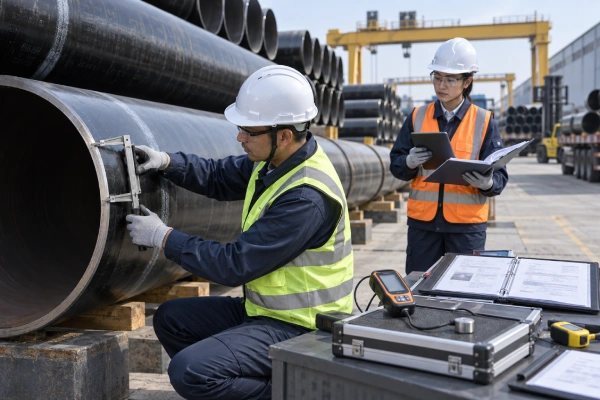
Define whether third-party inspection covers documents, dimensions, quantity, testing, coating or loading. Agree hold and witness points before production or allocation; completed operations cannot be witnessed retrospectively.
Steel Pipe Buying Guide: Prepare an RFQ That Can Be Quoted
A message asking only for “API pipe price” produces an indicative figure, not a dependable offer. A complete RFQ lets suppliers confirm availability, identify deviations and calculate inspection and delivery costs consistently.
Send the datasheet, material requisition or BOQ whenever one exists. Your covering enquiry should also summarize the commercial requirements below.
- Buyer and project name, where disclosure is permitted
- Pipe standard, edition, grade, PSL and manufacturing route
- OD or NPS, wall thickness or Schedule, length and quantity by item
- End preparation, coating, marking and packing requirements
- Required MTC, tests and third-party inspection scope
- Destination in Turkmenistan and preferred Incoterm
- Required delivery date and whether partial shipments are acceptable
- Offer validity, payment terms and document-submission schedule
Request a line-by-line compliance statement. “Complies with API 5L” is insufficient without the edition, grade, PSL, dimensions, tests and supplementary requirements.
Compare the Total Offer, Not Only the Price per Tonne
The lowest unit price can become the most expensive offer if it excludes coating, testing, inspection, packing or delivery. Normalize technically acceptable bids and keep every unresolved deviation visible.
Check the following points across shortlisted offers:
- Technical compliance and declared deviations
- Quantity basis, theoretical or actual weight and permitted tolerance
- Included documentation, testing and inspection
- Production or allocation lead time
- Packing, end protection and marking
- Freight basis, Incoterm and delivery point
- Payment milestones, offer validity and claims procedure
Rejecting a noncompliant offer early is less costly than resolving a mismatch after delivery.
Plan Packing, Delivery and Import Documents Early
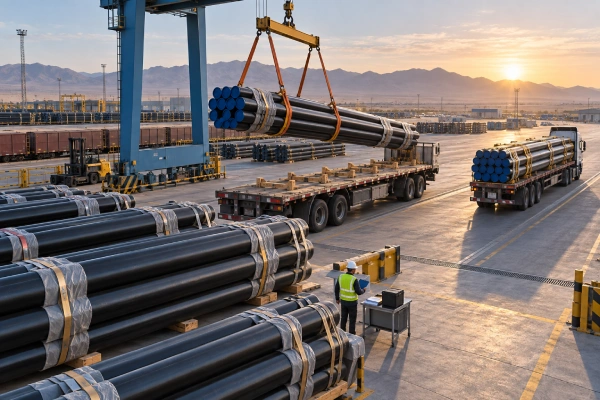
Long lengths, heavy bundles and coated surfaces require coordinated handling. Give the supplier the final destination, unloading limitations and delivery window. State the Incoterm with a named place and applicable version.
Before dispatch, align the invoice, packing list, certificate of origin, transport document and inspection package with the purchase order. FD Steels can coordinate these requirements through its international steel supply services, subject to the confirmed order and delivery terms.
Why Project Buyers Work with FD Steels
FD Steels combines long-standing steel-market experience with practical familiarity with Turkmenistan. Its international history includes a first steel-profile shipment to Turkmenistan in 2003. Read more on the FD Steels About Us page.
For project and factory enquiries, the team can review specifications, coordinate EN 10204 3.1 documentation, arrange agreed third-party inspection and prepare certificate-of-origin and export documents. API 5L availability depends on grade, PSL, manufacturing route, dimensions, quantity and mill, so each requirement is checked before a firm offer.
Request a Project-Specific Steel Pipe Quotation
For a Turkmenistan project, send FD Steels your datasheet or RFQ with the standard edition, grade, PSL, dimensions, quantity, inspection scope, destination and delivery date.
Contact FD Steels for a tailored steel pipe quotation. The team will review the requirement and confirm available options against your project specification.
Frequently Asked Questions
1. Can FD Steels quote every API 5L grade and size?
No blanket availability is assumed. Send the complete requirement, and FD Steels will check suitable options before issuing a firm quotation.
2. Should I request PSL1 or PSL2?
Use the level in the approved specification. Do not substitute PSL1 or PSL2 without engineering review of all associated requirements.
3. Can an EN 10204 3.1 MTC and third-party inspection be arranged?
Yes, when defined before order confirmation. State the certificate, inspection company, scope and witness or hold points in the RFQ.
4. What information produces the fastest accurate quotation?
Provide the standard and edition, grade, PSL, type, dimensions, quantity, ends, coating, inspection, destination, Incoterm and delivery date. Attach the BOQ or material requisition.
5. Is API 5L suitable for structural pipe in a large civil project?
Not automatically. A structural application may require another product standard and inspection regime. Confirm it with the structural engineer before ordering or accepting a substitute.